

ArangoDB database system
ArangoDB is a scalable graph database system to drive value from connected data, faster
ArangoDB combines the analytical power of native graphs with an integrated search engine, JSON support, vector indexes, and a variety of data access patterns via a single, composable query language.
ArangoDB is available in a community and a commercial edition. You can use it for on-premises deployments, self-managed cloud deployments, as well as a fully managed cloud service, the Arango Managed Platform (AMP).
What are Graphs?
Graphs are information networks composed of nodes and edges.
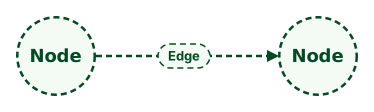
A social network is a common example of a graph. People are represented by nodes and their friendships by relations.
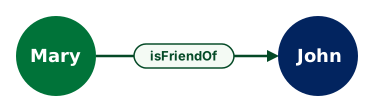
Nodes are also called vertices (singular: vertex), and edges are relations that connect nodes. A node typically represents a specific entity (a person, a book, a sensor reading, etc.) and an edge defines how one entity relates to another.
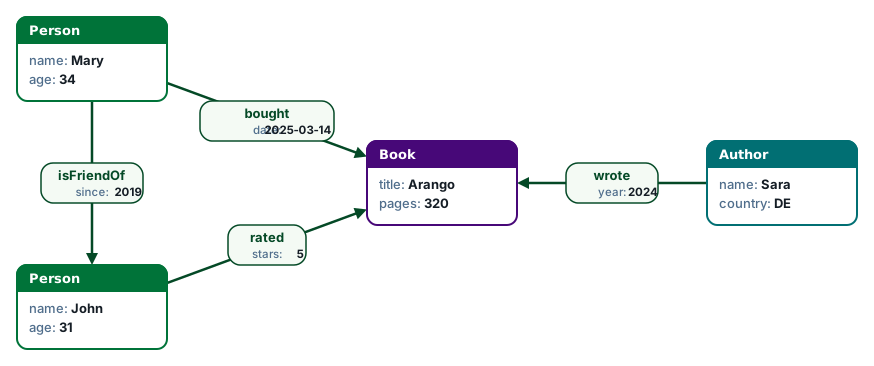
This paradigm of storing data feels natural because it closely matches the cognitive model of humans. It is an expressive data model that allows you to represent many problem domains and solve them with semantic queries and graph analytics.
Beyond Graphs
Not everything is a graph use case. ArangoDB lets you equally work with structured, semi-structured, and unstructured data in the form of schema-free JSON objects, without having to connect these objects to form a graph.
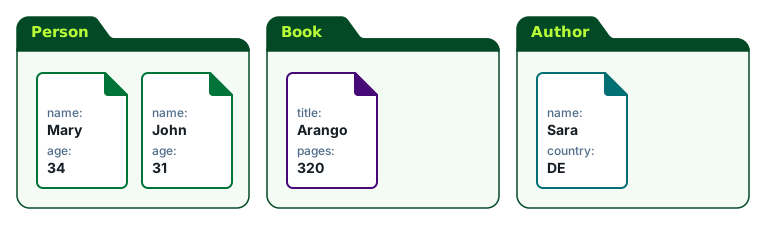
Depending on your needs, you may mix graphs and unconnected data. ArangoDB is designed from the ground up to support multiple data models with a single, composable query language.
FOR book IN Book
  FILTER book.title == "Arango"
  FOR person IN 2..2 INBOUND book bought, OUTBOUND isFriendOf
    RETURN person.name
ArangoDB also comes with an integrated search engine for information retrieval, such as full-text search with relevance ranking.
ArangoDB is written in C++ for high performance and built to work at scale, in the cloud or on-premises.